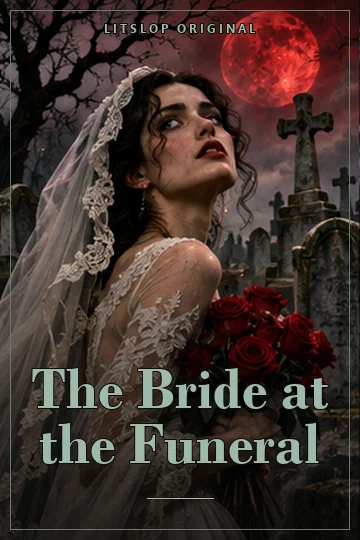
A Veil for the Dead
The bride arrived after the coffin had been lowered. She wore ivory silk, a veil stiff with rain, and a wedding ring on a finger so swollen the gold had cut the skin. Nobody at the graveside offered her an umbrella.
I knew her at once. She was the woman from the portrait in the east gallery, the one my husband had turned to face the wall. In the painting she held a sprig of rosemary; here she carried a bouquet of bare black stems. The portrait was dated 1891.
“Mrs. Vale,” she said. Her voice was soft enough that the priest leaned toward her. “I believe you have something of mine.”
My husband’s mother made a sound like a kettle beginning to boil. “You have no claim here.”
The bride looked down at the coffin. “He promised me a wedding.”
I had been married to Julian Vale for eleven months. He had told me he was thirty-four, that his father had drowned, and that the ruin above the lake was dangerous after dark. Two of those statements had already proved false. I did not ask which one she meant to correct.
The priest began the final prayer again. The bride stepped into the open grave. One moment she was beside me; the next she stood on the coffin lid, her skirts settling around her like pale water. A spade slid from the gardener’s hand. She laid her palm against the wood and closed her eyes.
“He isn’t in there,” she said.
I had seen Julian’s body. I had identified the scar on his shoulder, the crooked little finger he blamed on a schoolboy fight. I had also seen his mother insist that the coffin remain closed. I had thought it grief. It might have been a family habit.
The bride reached up to me. “Help me out.”
Her hand was cold, but it gripped mine with an ordinary, painful strength. I braced myself against the wet grass and pulled. Together we climbed out of the grave, ruining the hem of my black coat. My mother-in-law watched without moving.
“Your name?” I asked the bride.
“Clara Ash.”
“Did he love you, Clara?”
She considered. “He loved being forgiven.”
That answer made me trust her more than I wanted to. Julian had been generous in ways that required an audience, tender when I threatened to leave, and attentive whenever he feared a question. I had loved him anyway. That was not the same as being a fool, though it had occasionally produced the same results.
Clara lifted her veil. A red mark circled her throat, half hidden by lace. “He took my name the night before our wedding. Your name will be next, unless you come with me.”
My mother-in-law seized my arm. “She cannot cross the lake unless a wife invites her.”
“And you cannot keep him buried unless a wife stays,” Clara said.
Above the ruins, the moon rose through a break in the clouds, red as a fresh bruise. From the empty grave came three measured knocks. The mourners scattered. My mother-in-law held on, her nails biting through my sleeve.
I thought of the locked east gallery, of Julian’s careful hands, of the letter I had found in his desk addressed to a woman whose name had been scratched away. Then I pulled free and offered Clara my arm.
“Come home with me,” I said.
The knocking stopped. Across the lake, every window in the ruined house lit at once.
End of the free first chapter. Keep reading in the app · more gothic romance